|
Whereas common environmental and
occupational noise assessments are based
on the sound pressure level,
which is
a
scalar quantity that has only the
magnitude and is measured with a single
microphone,
sound intensity level
is a vector
quantity that has both the magnitude and
direction,
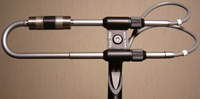
and is measured with a
sophisticated probe
of two carefully
spaced and opposite-directed microphones.
| |

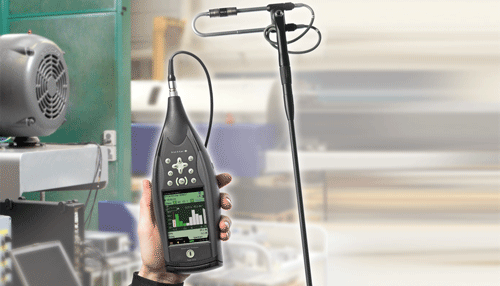
On the photograph, our measuring
equipment:
a hand-held sound intensity
system - Brüel & Kjær (B&K)
Modular
Precision Real-Time Sound Analyzer
type
2260 Investigator with Sound Intensity
Probe type 3595.
|
|
|
The advantages of
sound intensity measurements over
sound pressure measurements
include
the abilities to:
-
determine the
sound power level of a mechanical system (compressor,
lawn-mower,
air-conditioner, pump, fan)
in-situ, in your laboratory or
factory, without the necessity
of placing this system inside the
anechoic or reverberant chambers
(expensive) or in
the acoustically free-field (in many
cases unattainable);
-
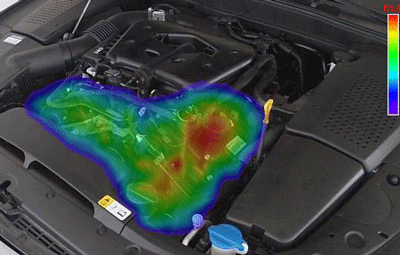
search for, pinpoint, rank and
quantify individually all
significant sub-sources of
noise
within
a mechanical system
(e.g. an air-conditioning unit),
such as compressors, cooling fans,
worn-out bearings, covering panels,
motors, gear boxes and supporting
structure - this permits effective,
optimally targeted
(informed) noise
reduction modifications; and
-
scan walls, windows, doors, floors
and ceilings
to determine, which of these
elements
or their part(s)
are
acoustically inadequate and need to
be replaced or reinforced.
The great merit of measurements of the sound intensity
is that these measurements allow
to
isolate acoustically different
sources of noise that work (have
to work) together, close to one another.
For example, if you have a pumping
station where a number of pumps work
simultaneously (cannot be
switched off
separately), you may determine the
individual sound power level of each of the pumps
by measurements of the sound intensity
over each of the pumps in the presence of noise from the
remaining
pumps operating
in background.
If you need to:
|
1. |
determine
sound
power level
of your products for technical
specifications, sale contracts
or legal requirements;
|
|
2. |
carry-out a modern
noise reduction program
for your products or equipment
that you use;
|
|
3. |
decrease transmission of noise
between two rooms;
|
|
4. |
reduce the
impact of aircraft or road
traffic noise
affecting
your office, residence and/or
school;
|
|
5. |
control
noise escaping from your
factory building, sound studio,
discothèque and/or club; |
E-mail
PCCD for a free
introductory consultation and quotation
for the measurements of sound intensity.
Although
the sound intensity technology:
a. allows to
resolve noise problems in the
scientifically most advanced
and
effective way; and
b. in many cases
is absolutely indispensable;
there are only few acoustical
consultants in Sydney that use this
technology due to the high cost of
required
measuring equipment and/or lack
of expertise.
|